DIY vs. Professional Tree Removal: Risks, Costs, and What to Know
Small trees under 15 feet can sometimes be DIY. Anything bigger carries real risks. Here's how to decide, and what it costs either way.
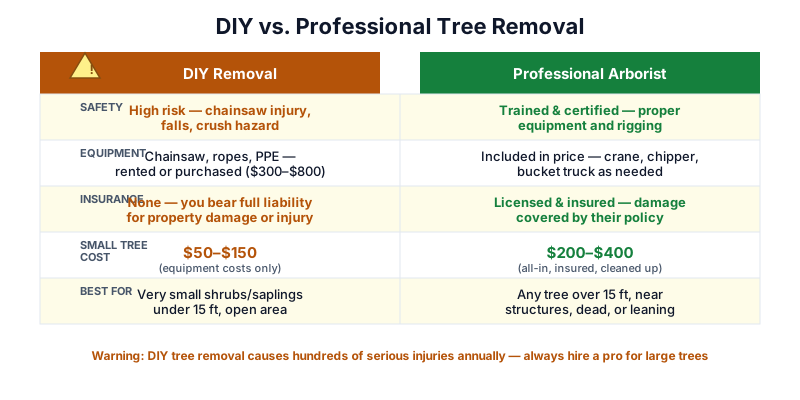
Tree removal sits in an interesting category of home improvement: technically possible to do yourself on the smaller end, genuinely dangerous on anything medium-sized or above, and complicated enough in both cases that most people underestimate what it actually involves.
This isn't a scare piece. Some trees are perfectly appropriate for a confident homeowner with the right tools. But some aren't, and the consequences of misjudging which category yours falls into are severe. Here's an honest breakdown.
When DIY Tree Removal Is Reasonable
The short version: small tree, open area, clear drop zone, no power lines, no structures in the fall radius.
More specifically, you're probably in reasonable DIY territory if:
- The tree is under 15 feet tall
- The trunk is under 6 inches in diameter
- It's standing (not significantly leaning)
- There's a clear drop zone at least 2x the tree's height in the target direction
- No structures, fences, or utility lines are within that drop zone
- You're physically comfortable with a chainsaw
If your situation doesn't check all five boxes, you're in professional territory. That's not an arbitrary line, it's where the physics and the injury statistics start shifting against you.
The Realistic DIY Candidate
A 12-foot ornamental pear growing in the middle of your yard, healthy, vertical, with open lawn in every direction. You can notch it, make a back cut, and it drops cleanly. The whole operation takes 90 minutes and a cheap chainsaw.
That's DIY. A 45-foot oak growing toward your garage is not.
What the Injury Statistics Actually Say
The CDC tracks fatalities from tree-cutting operations. According to their occupational data, approximately 80 fatalities per year occur in tree care work. That number includes professionals, but it reflects the baseline danger of the activity even for people who do it every day.
Non-professional tree cutters face higher per-incident injury rates because they lack rigging skills, don't have proper equipment, and often misjudge tree lean and hinge behavior during felling. The most common serious injuries are:
- Struck by, a falling limb or the tree itself changing direction unexpectedly
- Falls, climbing or working from a ladder
- Chainsaw kickback, the chain binding and the saw kicking back toward the operator
- Crush injuries, from improperly rigged sections
The "struck by" category is the one that kills people. A branch that swings back, a tree that falls the wrong way, a heavy limb that bounces, these happen even when the cut looks straightforward. Professional crews train specifically to anticipate and control these forces.
What DIY Actually Costs in Equipment
If you don't own the tools already, DIY tree removal costs more than most people expect. Here's a realistic equipment list for a tree in the 10–18 foot range:
| Equipment | Purchase Cost | Rental Cost (1 day) |
|---|---|---|
| Chainsaw (14–16" bar) | $200–$400 | $50–$80 |
| Chainsaw chaps (safety) | $80–$150 | , |
| Helmet with face shield | $50–$120 | , |
| Work gloves (cut-resistant) | $30–$60 | , |
| Safety boots (steel toe) | $80–$200 | , |
| Rope (for directional pull) | $30–$60 | , |
| Wood chipper (for branches) | , | $150–$250 |
Buying the chainsaw and full safety kit runs $470–$990 before you touch the tree. Renting most of it gets you to $230–$390 for the day, assuming you already own boots and gloves.
For a single small tree, that's not necessarily a bad deal compared to a $300–$500 professional quote. But for a tree that turns out to be harder than expected, one hung-up branch, one section that pinches the bar, you're now paying rental fees on equipment you can't use until you solve a problem you don't have the skills to solve.
The Log Disposal Problem
One thing DIY guides routinely gloss over: what do you do with the wood?
A 15-foot tree produces a significant volume of branches, brush, and trunk sections. Most municipalities limit yard waste to a few bags per week. Renting a chipper handles branches, but trunk sections 6+ inches in diameter don't fit in standard chippers. You're hauling those to a transfer station yourself or stacking them as firewood, which requires a splitter and somewhere to store it.
Professional crews bring their own chipper and haul everything away. That's included in the quote.
What Professional Removal Costs
Based on industry data from TCIA and ISA benchmarks, professional removal runs:
- Small tree (under 25 ft): $300–$500
- Medium tree (25–50 ft): $700–$1,100
- Large tree (50–75 ft): $1,200–$1,900
- Very large (75–100 ft): $2,000–$3,000
These assume a healthy tree in a reasonably open location. A tree near your house adds 30–60% to the base cost depending on proximity. A dead or leaning tree adds 15–35%.
For a medium tree near a structure, you might pay $1,200–$1,600. That same job done wrong as a DIY costs you a broken fence at best, a damaged roof or hospitalization at worst.
Use the tree removal cost calculator to get a specific range for your tree, you enter height, trunk diameter, condition, and location and get a realistic low-to-high estimate.
What ISA Certification Means (And Why It Matters)
The International Society of Arboriculture (ISA) certifies arborists who pass a knowledge exam covering tree biology, climbing and rigging techniques, diagnosis, and safety. As of 2026, there are roughly 25,000 ISA Certified Arborists active in North America.
ISA certification doesn't license someone to remove trees, licensing varies by state and municipality, but it does signal that the person understands tree structure, knows how to assess failure risk, and has been tested on safe work practices.
You can verify any ISA certification number at isa-arbor.com. It takes 30 seconds and confirms the certification is current (they expire and require continuing education to renew).
The Tree Care Industry Association (TCIA) has a separate accreditation program for companies, covering business practices, safety compliance, and insurance. Their "Find a Tree Care Company" tool at tcia.org filters for accredited companies by zip code.
Hiring someone off a neighborhood app without verifiable certification or insurance is the tree removal equivalent of hiring an unlicensed electrician. It might work out fine. It might not.
The Insurance Question
Before any crew starts work on your property, verify:
- General liability insurance, covers property damage if they drop a section on your fence, car, or house
- Workers' compensation, covers their crew if someone is injured on your property
If a crew member is hurt on your property and the company doesn't carry workers' comp, your homeowner's insurance can be on the hook. Ask for certificates of insurance before work starts. Any legitimate company will have these ready.
For DIY work, your standard homeowner's policy typically covers accidental property damage you cause, but not medical bills if you injure yourself. If you're a renter, you likely have no coverage at all.
When You Should Definitely Hire a Professional
Some situations aren't judgment calls. Hire a pro if:
- The tree is within 10 feet of your house, improper rigging can put a section through your roof
- There are power lines anywhere near the tree, the utility company needs to de-energize lines before anyone works near them; this requires coordination and sometimes a permit
- The tree is dead, dead wood is unpredictable; branches can detach at any point during cutting
- The tree has a visible lean toward a structure, controlling the fall direction on a leaning tree requires expertise in hinge cutting and sometimes rigging
- The tree is over 25 feet tall, at this height, the physics of a bad cut become unmanageable without professional rigging
- You're unsure, if you're reading a list of warning signs and thinking "maybe this applies to me," that's a signal to call an arborist
For context on what constitutes a hazard tree, see our guide on when to remove a tree. If a permit is involved, our permit guide walks through what's typically required.
Making the Decision
Here's a simple framework:
DIY is reasonable if:
- Under 15 feet tall, open drop zone, no structures nearby, you have proper safety gear, and you're confident with a chainsaw
Professional is required if:
- Over 25 feet, near any structure, near power lines, dead or storm-damaged, leaning, or you're not confident in any of the above
For the middle range, 15–25 feet, reasonably open, it's a judgment call based on your specific site and your experience level. When in doubt, a consulting fee with an ISA arborist (typically $75–$150 for an on-site assessment) is money well spent. They'll tell you honestly whether it's a DIY-appropriate job.
When DIY Makes Sense
DIY tree removal isn't inherently irresponsible. But it's narrowly appropriate, and the line between "manageable" and "dangerous" is much lower than most people assume.
If your tree is under 15 feet, standing straight, in a clear open area, go ahead. Get the right gear, follow the notch-and-back-cut technique, and you'll save $300–$500.
If it's anything larger, near anything valuable, or in any compromised condition, the cost of professional removal is the cost of not finding out the hard way what happens when a tree doesn't fall the way you planned.
Want to know what professional removal would cost for your specific tree? Get an instant estimate using our cost calculator, it factors in size, condition, and location to give you a real-dollar range in under a minute.
Learn more about how we build these estimates on our about page.