When to Remove a Tree: 8 Signs It's Time to Call an Arborist
Not every troubled tree needs to come down, but some do. Here are 8 signs that removal is the right call, and what it'll cost to wait.
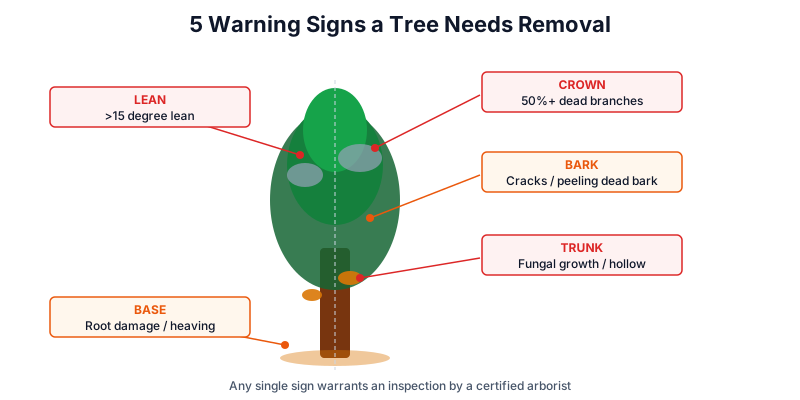
Trees give you signals before they fail. The problem is most homeowners don't know what they're looking at, or they spot something concerning and talk themselves out of doing anything about it because removal seems expensive or disruptive.
This post covers 8 specific signs that a tree needs professional attention, which of those signs indicate removal versus treatment, and what the cost of waiting actually looks like in dollar terms.
A note upfront: diagnosing trees is genuinely complex, and this guide is meant to inform your conversation with an arborist, not replace one. The ISA recommends a certified arborist assessment for any tree that poses potential risk to structures or people.
Sign 1: More Than 50% Dead Wood in the Crown
Look up into the crown on a spring or summer day when healthy trees are in full leaf. Dead branches have no leaves, or they've leafed out weakly and dropped early. If more than half the crown looks dead or sparse, the tree's vascular system is compromised.
This matters because dead branches don't flex, they break. A dead branch over a walkway, driveway, or roofline is a falling hazard waiting on a windstorm. The TCIA's guidance on hazard trees flags crown dieback as one of the primary indicators for assessment.
What to do: Get an ISA-certified arborist to assess it. In many cases, significant deadwood indicates systemic root or vascular disease, the tree won't recover, and removal is the right call. For partial crown dieback, crown cleaning (removing the dead wood) may extend the tree's life.
Dead tree removal typically runs 15% more than removing a comparable healthy tree, dead wood is unpredictable to work with, so crews charge for the extra care. See our full breakdown on dead tree removal costs.
Sign 2: A Lean That Wasn't There Before
Trees grow with a natural lean, that's not necessarily concerning. What's concerning is a lean that has developed or worsened over months, which suggests the root system is failing.
Look for soil heaving on the opposite side of the lean. If the ground is pushing up, the root plate is lifting, the tree is actively tipping. That's not a trimming problem. That's a removal situation.
A significantly leaning tree costs 35% more to remove than a vertical one (multiplier of 1.35x applied to the base cost) because controlling the fall direction requires more rigging work and a longer time on-site.
What to do: Don't wait on this one. A tree that's actively leaning toward a structure is a liability. Call an arborist for an emergency assessment.
Sign 3: Significant Root Damage
Root damage is sneaky because you can't see it directly. Look for these indicators:
- Recent trenching, excavation, or construction within the drip line (the area under the outer edge of the crown)
- Cut or crushed roots visible at the surface after grading work
- Soil compaction from vehicles driven repeatedly over the root zone
- New pavement or concrete poured over an active root system
The ISA's research shows that damage to more than 30–50% of a tree's root system significantly increases failure risk, sometimes not immediately, but within 2–5 years as the tree loses structural anchor capacity.
What to do: If you've had construction near a mature tree in the last 3 years and the tree is showing any of the other signs on this list, get an assessment. There's no DIY fix for root system damage.
Sign 4: Trunk Decay or Cavities
Cavities in a trunk, hollow spots, soft wood, crumbling bark, indicate internal decay. The tree may still be alive and leafing out, but the structural wood that holds it up is compromised.
A simple test: knock on the trunk in several spots. A solid healthy trunk sounds dense. A hollow section sounds different, more resonant, sometimes hollow-sounding.
Don't probe cavities with a tool to check depth unless an arborist is present. Disturbing decayed wood can accelerate the structural problem and, in some cases, dislodge a section that's load-bearing.
What to do: Trunk cavities under 30% of the trunk's circumference may be manageable with cabling and bracing. Cavities affecting more than 30–50% of the circumference typically indicate removal is safer than attempting to preserve the tree.
Sign 5: Fungal Growth on or Near the Trunk
Fungal fruiting bodies, conks, brackets, mushrooms at the base, are a reliable indicator of internal wood decay. The visible fungus is the reproductive structure; the actual organism is typically throughout the wood of the trunk or root system.
Common species to know:
- Ganoderma species (artist's conk, varnish shelf), grows on living trees and indicates advanced butt rot. Removal is almost always recommended.
- Armillaria mellea (honey fungus), produces honey-colored mushrooms at the base in clusters, often in fall. Attacks the root system. Aggressive spreader.
- Laetiporus sulphureus (chicken of the woods), bright orange/yellow bracket. Indicates active decay of heartwood.
What to do: Photograph and show to an ISA-certified arborist. Don't remove the fungal growth, it's evidence, not the problem. If the pathogen is Armillaria, full root system removal (not just grinding) is worth considering to protect nearby trees.
Sign 6: Cracks or Splits in the Trunk or Major Limbs
A crack running vertically or diagonally through the trunk is a structural red flag. Cracks indicate that the wood has experienced stress beyond its tensile strength, often from previous storm damage, lightning strikes, or freeze-thaw cycles opening existing weaknesses.
Not all cracks are equal. A shallow surface crack in the bark is cosmetic. A crack that penetrates into the sapwood or heartwood is structural. Width matters too, cracks that open and close with temperature changes are active and indicate ongoing movement.
What to do: Cracks in major limbs can sometimes be addressed with cabling, a tension system that limits limb movement. Trunk cracks rarely have a good structural solution. An arborist can measure crack depth with a resistograph (a drill-bit probe that maps wood density) and give you an honest prognosis.
Sign 7: The Tree Is Within Striking Distance of Your House
This one is less about tree health and more about site geometry. A healthy tree can still be a removal candidate if it's positioned to cause major damage if it fails.
The calculation is straightforward: if the tree's height is greater than the distance from its base to your house (or any occupied structure), a complete failure would reach the building. That's true even for healthy trees, it just means you're carrying ongoing risk even with no current disease present.
This consideration intensifies if:
- The tree is over 50 feet tall
- There's a significant crown mass overhanging the roofline
- The species is known for brittle wood (Bradford pear, silver maple, willow)
Removing a tree over your house costs 60% more than the same tree in an open area (1.6x multiplier), because every section must be rigged and lowered, no felling. But that's still far less than the cost of a section through your roof.
For more on the specific cost dynamics of trees near houses, see our guide on tree removal near houses.
What to do: If a healthy tree is positioned to cause serious damage on failure, the decision is a risk management one. Talk to your homeowner's insurance agent about whether you have coverage for tree damage, many policies have specific exclusions for known hazards.
Sign 8: Storm Damage Has Left the Tree Structurally Compromised
After a major storm, trees get assessed as one of three things: fine, damaged-but-recoverable, or compromised beyond practical repair.
Signs of non-recoverable storm damage:
- More than 50% of the crown is gone
- The trunk has a major crack or split that runs through the structural wood
- The root system has partially lifted (visible at the base)
- Large co-dominant stems (two main trunks growing from the same point) have split apart
Don't wait months to assess a storm-damaged tree. Storm-damaged trees cost 25% more to remove than healthy ones, the multiplier accounts for unpredictable wood behavior. But a damaged tree that falls on its own often causes tens of thousands of dollars in property damage.
What to do: After any storm that visibly damages a tree near your house, get an emergency assessment within a week. Many arborists offer storm response assessments on short timelines.
The Cost of Waiting
Here's what homeowners often don't account for: the cost of not removing a tree that needs to come down.
A dead 50-foot oak costs roughly $1,380–$2,392 to remove professionally (base $1,200 × 1.15 condition multiplier = $1,380, with the high end at 1.3× that). If it falls on a fence, add $1,000–$3,000 in fence repair. If it falls on a car, add $5,000–$15,000. If it falls on your roof, add $8,000–$50,000 depending on where it hits.
Removal is insurance against a much larger number. The tree that falls on your neighbor's property can also become a liability claim against you if you knew or should have known it was hazardous.
When Removal Isn't the Answer
Not every concerning sign means removal. Consider these alternatives first:
Crown cleaning, removing dead, diseased, and crossing branches, can significantly extend the life of a tree with partial deadwood. This costs $200–$600 for most medium trees.
Cabling and bracing, installing tension systems between co-dominant stems or beneath heavy limbs, reduces failure risk without removing the tree. Appropriate for structurally sound trees with specific mechanical weak points.
Fertilization and soil management, for trees showing signs of decline due to soil compaction or nutrient deficiency, aerating the root zone and adding organic matter can reverse the decline.
An ISA-certified arborist's assessment (typically $75–$150 for a residential property) will tell you honestly whether any of these alternatives are viable for your specific tree.
Getting a Removal Quote Once You've Decided
If you've assessed the signs and decided removal is the right call, the next step is understanding what it'll cost. Key variables: tree height, trunk diameter (measured at chest height), condition, and how close it is to structures.
Our tree removal cost calculator runs the full formula, including condition and location multipliers, and gives you a low-to-high range before you call anyone. Going into the conversation knowing your range means you can evaluate quotes accurately rather than accepting the first number you hear.
For more context on removal costs, see how much does tree removal cost and our guide on DIY vs. professional removal.
Learn more about how our cost estimates work on our about page.