Tree Removal Near a House: What It Costs and How It Works
Removing a tree near your house costs 30–60% more than open-area removal. Learn why, what the process involves, and how to protect your home.
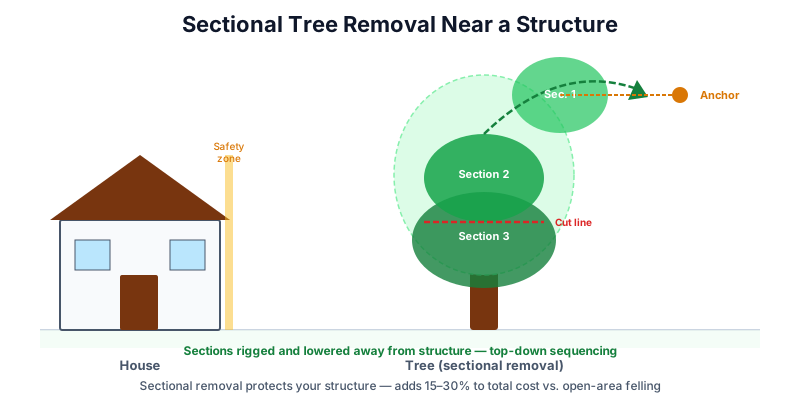
Removing a tree that's sitting in the open is one thing. Removing one that's hanging over your roof, wedged against your siding, or growing within 10 feet of your foundation is a completely different job, and a significantly more expensive one.
If you've got a tree close to your house, you're looking at a 30–60% premium over standard removal prices. That's not arborists taking advantage of you. It's the reality of working in a tight, high-stakes environment where one mistake can punch a hole through your roof or collapse your gutters.
Here's exactly what you're paying for, how the work gets done, and what to watch out for when hiring someone to do it.
Why Proximity to Your House Drives Up the Cost
The Tree Care Industry Association (TCIA) categorizes tree removal risk partly by access and drop zone. When a tree is near a structure, arborists can't simply cut it and let it fall. Every section has to be rigged, lowered, and controlled, piece by piece.
That takes more time, more equipment, and more crew members. A tree that might take 2 hours to remove in an open yard can take 6–8 hours when it's growing over a roof.
Our tree removal cost calculator applies location multipliers that reflect this reality:
- Near a structure (within ~15 feet): 1.3× base cost
- Over a structure (canopy directly above): 1.6× base cost
- Near power lines: 1.5× base cost
- Confined backyard with limited access: 1.25× base cost
So a large tree (60 feet, $1,200 base cost) positioned directly over your house is calculated at $1,200 × 1.6 = $1,920 before any other factors. Add stump grinding, a diameter surcharge for a wide trunk, or a dead/leaning condition, and you're looking at $2,500–$3,500 for most realistic scenarios.
The Sectional Removal Process
When a tree can't fall freely, arborists use sectional dismantling. Think of it as taking the tree apart from the top down, rather than cutting it at the base and directing the fall.
How It Actually Works
A certified arborist climbs the tree or uses a bucket truck to reach the upper canopy. Working top-down, they cut sections, typically 8–12 feet long, and use ropes and rigging hardware to lower each piece in a controlled arc away from the house.
The rigging system involves:
- Redirect pulleys anchored to the trunk or a nearby anchor tree to change the direction of the load
- Friction devices (like a Porta-Wrap) that let the groundsman control the descent speed
- Taglines to prevent sections from swinging into walls or windows
This requires at least two people working in sync, the climber cutting above, the groundsman managing ropes below. On larger trees you'll often see a crew of 3–4 people.
When a Crane Is Required
For very large trees (80+ feet) or trees with extremely limited ground access, some companies bring in a crane. The crane operator positions a boom over the tree, and the climber attaches a rigging line to each major section before cutting. The crane holds the weight and swings it clear of the house in one controlled motion.
Crane rental typically runs $300–$500 per hour. That's why crane removals are priced at $3,000–$7,000 or more for large trees. It sounds expensive, but for a tree that's genuinely over your roof with no room to work, it may be the only safe option, and it's often faster than hours of traditional rigging.
Ask your arborist upfront whether they plan to use a crane. If they say yes, confirm whether the crane cost is included in their quote or billed separately as a day-rate.
Protecting Your Roof, Siding, and Gutters
Even with careful rigging, things happen. Wood sections shift, ropes slip, and pieces don't always land exactly where planned. A reputable company will take precautions before the first cut:
- Plywood shields laid over exposed roof sections below the work zone
- Rope padding on gutters where rigging lines run over the edge
- Tarps on landscaping and finished surfaces below
Before work starts, do a walkthrough with the crew lead. Point out anything fragile or valuable, a sunroom with polycarbonate panels, solar arrays, satellite dishes, AC units, or skylights. Get these noted in writing before the job begins.
Take dated photos of your roof, gutters, and siding before the crew starts. If any damage is later disputed, you'll have before-and-after documentation.
What to Ask Your Arborist Before They Start
Not every arborist who shows up with a chainsaw is qualified to do near-structure work safely. Here's what to ask:
Are you ISA-certified? The International Society of Arboriculture (ISA) certifies arborists who demonstrate knowledge of tree biology, rigging, and safe work practices. Near-structure work warrants this credential, don't skip it.
Do you carry liability insurance and workers' comp? If a section goes through your roof and the crew isn't insured, you're filing a homeowner's claim for someone else's mistake. Ask to see the certificate of insurance, not just their word for it.
Will you use rigging or a crane? Understanding their plan tells you whether they've actually assessed the job or just gave you a number over the phone.
What's included in the quote? Debris hauling, stump grinding, and cleanup are often separate line items. Clarify before you sign anything.
Can you show me recent similar work? Photos of past near-structure removals tell you more than any sales pitch.
For a deeper look at what drives quotes up and down, the tree removal cost factors guide breaks down every variable arborists consider when pricing a job.
A Realistic Quote: Large Tree Over a Structure
Here are the numbers on a realistic scenario.
The tree: A 65-foot silver maple, approximately 30 inches in diameter, with the main canopy extending directly over a two-story house.
Step 1, Base cost by height: Large tree (50–75 ft) = $1,200
Step 2, Diameter surcharge: 30 inches is 6 inches over the 24-inch threshold. 6 × $25 = $150
Step 3, Condition multiplier: The tree is healthy = 1.0× (no change)
Step 4, Location multiplier: Canopy over the structure = 1.6×
Subtotal: ($1,200 + $150) × 1.6 = $1,350 × 1.6 = $2,160
Step 5, Stump grinding: 30-inch diameter. $150 + (30 × $3) = $150 + $90 = $240
Total: $2,160 + $240 = $2,400
Low-end estimate: $2,400 × 0.75 = $1,800
High-end estimate: $2,400 × 1.30 = $3,120
So for this tree, expect quotes in the $1,800–$3,120 range, with most landing around $2,400. That's a fair benchmark to hold incoming bids against.
How This Compares to Open-Area Removal
Run the same tree without the structure, open backyard, clear fall zone:
Subtotal (no location multiplier): ($1,200 + $150) × 1.0 = $1,350
With stump grinding: $1,350 + $240 = $1,590
The difference between open-area and over-structure removal for this one tree is nearly $810, about 50% more. That's the real cost of proximity.
You can run these calculations for your specific tree using the free tree removal cost estimator. Enter your tree's height, diameter, condition, and location and you'll get a detailed breakdown in under a minute.
After the Tree Is Down
Once sections are on the ground, the job isn't finished. A reputable crew will:
- Cut logs to manageable lengths for hauling or stacking
- Run branches through a chipper on-site
- Rake and blow the work zone clean
- Grind the stump if it's in the scope
Some homeowners want to keep the wood for firewood. Hardwoods like maple, oak, and ash are worth keeping, they burn well after 6–12 months of drying. Softwoods like pine or cottonwood aren't worth the storage space. Just have them haul it.
Timing Your Near-House Removal
If the tree isn't an immediate hazard, winter is often the best time to schedule near-structure work. Leafless canopies are easier to assess, frozen ground reduces lawn damage from equipment, and most crews have more availability in January–March, which often translates to better pricing.
That said, don't delay if the tree is leaning toward the house, showing signs of decay, or was damaged in a storm. Those situations only get more dangerous, and more expensive, with time. The dead tree removal cost guide covers how quickly structural deterioration affects both safety and price.
For trees that are 80+ feet tall, the large tree removal cost breakdown covers crane costs, crew size, and what the full price picture looks like for really big trees.
Should You Take the Tree Down
Removing a tree near your house isn't a job to cut corners on. The risks are real, structural damage, injury, liability, and the right crew costs more for good reason.
Plan for a 30–60% premium over open-area removal. Get at least 3 quotes. Verify ISA certification and insurance before anyone starts. And take photos of your property before the first chainsaw comes out.
Ready to see what your specific tree might cost? Use our free tree removal cost calculator to get a detailed breakdown based on your tree's height, diameter, condition, and exact location relative to your home.
You can read more about how this site's estimates are built on the about page.