7 Factors That Affect Tree Removal Cost (And How to Manage Them)
Tree removal quotes vary by hundreds of dollars. Here are the 7 factors arborists use to price jobs, and how to keep costs reasonable.
You've gotten two quotes for the same tree, one is $900, the other is $1,600. Both arborists seem competent. So what gives?
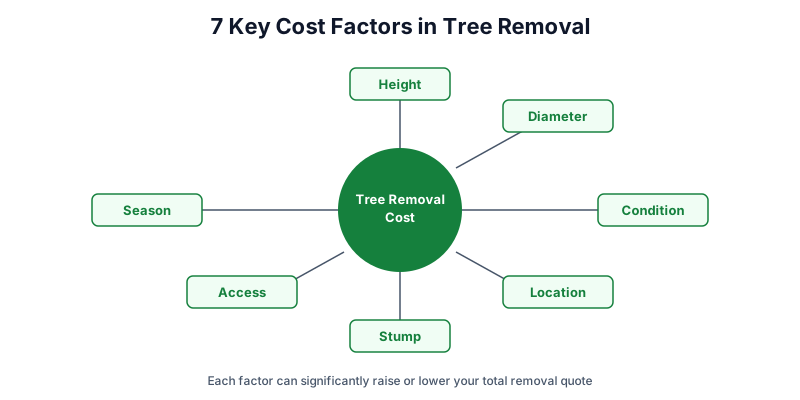
Tree removal pricing isn't arbitrary. It follows a fairly consistent logic that ISA-certified arborists and TCIA-member companies use to account for time, equipment, and risk. Once you understand the 7 factors driving the price, you'll know exactly why quotes differ, and which ones you can actually influence.
1. Tree Height: The Foundation of Every Quote
Height is the starting point for every estimate. Arborists categorize trees into five size classes:
| Size Class | Height Range | Base Cost |
|---|---|---|
| Small | Up to 25 ft | $300 |
| Medium | 25–50 ft | $700 |
| Large | 50–75 ft | $1,200 |
| Very Large | 75–100 ft | $2,000 |
| Extreme | 100 ft+ | $3,500 |
Height affects almost everything: how long it takes to cut, how many lifts or climbs are needed, how far debris falls, and how much rope rigging is required to control the drop.
What you can do: Not much, a tree is whatever height it is. But knowing the size class means you can quickly sanity-check any quote against these baselines.
2. Trunk Diameter: The Overlooked Surcharge
Height alone doesn't capture how much wood is actually in a tree. A 60-foot tree can have a 20-inch trunk or a 42-inch trunk, those are completely different jobs.
The standard industry surcharge kicks in at 24 inches of trunk diameter. Above that threshold, expect $25 per inch added to the base cost. So:
- 30-inch trunk: (30 − 24) × $25 = $150 surcharge
- 40-inch trunk: (40 − 24) × $25 = $400 surcharge
- 48-inch trunk: (48 − 24) × $25 = $600 surcharge
Diameter is measured at breast height (DBH), which is 4.5 feet from the ground. If a tree forks below that point, each stem is often measured separately.
What you can do: Nothing changes the trunk, but measuring it yourself before calling lets you catch quotes that are using different trunk sizes as a basis.
3. Tree Condition: Why Dead Trees Cost More
It's counterintuitive, a dead tree seems easier to cut down. But dead wood behaves unpredictably. Branches can snap under their own weight during cutting, making it harder to control where wood falls. Root decay can make trees unstable at the base, requiring extra caution during felling.
Here's how condition multiplies the base cost:
- Healthy: 1.0x (no change)
- Dead: 1.15x (15% more)
- Storm-damaged: 1.25x (25% more)
- Significantly leaning: 1.35x (35% more)
A leaning tree that's also dead combines both multipliers in the risk assessment, even if only one is applied in the formal quote. The arborist's judgment about how unpredictably the tree will behave drives this.
What you can do: Don't delay. A healthy tree that dies or falls over in a storm will cost significantly more to remove. If a tree is showing signs of decline, get a quote now, see our guide on when to remove a tree for the warning signs.
4. Location and Access: The Biggest Swing Factor
Where the tree sits relative to your house, power lines, and your property boundaries can double the price. This is the factor that explains most of those big quote discrepancies.
Location multipliers applied to the adjusted base:
- Open area (no obstacles): 1.0x
- Near a structure (within 10–15 ft): 1.3x (30% more)
- Directly over a structure: 1.6x (60% more)
- Near active power lines: 1.5x (50% more)
- Confined backyard (limited swing room): 1.25x (25% more)
The over-structure scenario is the most expensive because the crew can't fell the tree, every section has to be rigged and lowered manually. A job that takes 3 hours in an open field takes 6–8 hours over a garage.
Power line proximity is handled differently by some companies. Many arborists won't work within 10 feet of energized lines and will require the utility company to de-energize first, that's a separate cost and scheduling process.
What you can do: Clear what you can. If equipment access is an issue, removing a fence panel so the crew can bring in a chipper or bucket truck can meaningfully reduce the price. Ask arborists directly: "Is there anything about access that's adding to this quote?"
For more on trees close to structures, see our post on tree removal near houses.
5. Stump Treatment: The Add-On That Catches People Off Guard
Most removal quotes don't include stump work. You'll get the tree down and a stump left standing unless you specifically ask and pay extra.
Two options:
Stump grinding chips the stump down 6–12 inches below grade. The roots stay in the ground and decay over 3–7 years. Cost formula: $150 + $3 per inch of diameter
- 20-inch stump: $150 + $60 = $210
- 36-inch stump: $150 + $108 = $258
Full stump removal excavates the root ball entirely. Cost formula: $300 + $8 per inch of diameter
- 20-inch stump: $300 + $160 = $460
- 36-inch stump: $300 + $288 = $588
If you're planting another tree in the same spot or building anything over that area, full removal is worth the extra cost. For most lawns, grinding is sufficient and much faster.
What you can do: Bundle stump work with the tree removal and ask for a package price. Most arborists will discount slightly when it's all one job since the equipment is already there.
For a deeper comparison, see our full guide: stump grinding vs. full stump removal.
6. Site Access: Equipment Gets Expensive When It Can't Move
Arborists work most efficiently when they can bring a bucket truck or large chipper close to the tree. When that's not possible, because of a narrow gate, a steep slope, or a walled property, everything slows down.
Manual climbing work costs more than bucket truck work. Carrying cut sections by hand to a chipper parked on the street doubles or triples the time for large trees.
Specific access issues that add cost:
- Gate width under 36 inches (standard for most large equipment)
- Slopes over 15% gradient
- Properties with low overhanging wires across the driveway
- Long carry distances from tree to road (over 150 feet)
What you can do: Measure your gate before calling. A 36-inch-wide gate can sometimes be widened temporarily by removing the gate itself, takes 20 minutes and saves potentially $200–$400 in labor.
7. Timing and Seasonality: Winter Is Actually Cheaper
Tree work follows a seasonal demand curve. Late spring through early fall is busy season, storms knock trees down, homeowners want their yards cleared before summer, and the work is generally pleasant.
Late winter (January–March) is the slowest stretch for most tree crews in the Northeast, Midwest, and Pacific Northwest. Crews are available, overhead is the same, and many will offer 10–15% off to fill their schedule. Deciduous trees are also easier to work on in winter, no leaves means better visibility through the crown and less debris volume to chip.
There's a practical downside: frozen ground can make equipment harder to move without damaging turf, and very cold temperatures affect some equipment operations.
What you can do: If the tree isn't a hazard, schedule removal in January or February. Mention to arborists you're flexible on date, that signal alone sometimes brings a better price.
Putting It Together: A Full Cost Example
Take a 55-foot maple with a 32-inch trunk. It's leaning slightly toward your fence (near structure), and you want the stump ground.
- Base cost (large, 50–75 ft): $1,200
- Diameter surcharge (32" − 24" = 8" × $25): +$200 → subtotal $1,400
- Condition multiplier (leaning, 1.35x): $1,400 × 1.35 = $1,890
- Location multiplier (near structure, 1.3x): $1,890 × 1.3 = $2,457
- Stump grinding (32" diameter): $150 + (32 × $3) = $246
Estimated range: $2,457 × 0.75 = $1,843 (low) to $2,457 × 1.30 = $3,194 (high), plus $246 stump work.
All-in estimate: $2,089–$3,440
That's a wide range, and that's realistic. Regional labor rates, crew size, and individual company overhead all push within that band.
Want to run your specific numbers? Our tree removal cost estimator covers all 7 factors above and outputs a low-to-high range based on your tree's actual measurements and conditions.
Where Your Money Actually Goes
Of the 7 factors, location is usually the one that surprises homeowners most. A tree that costs $700 in an open field can cost $1,820 over a structure, same tree, very different job.
Know your numbers before you call. Measure height (or estimate by comparison with your house), measure trunk diameter at chest height, and be honest about how close the tree is to anything it could damage. That puts you in a much stronger position to evaluate quotes fairly.
See our full cost breakdown in how much does tree removal cost and our deep-dive into large tree removal costs if you're dealing with a significant specimen.
Learn more about how these estimates are built on our about page.