Large Tree Removal Cost: What to Expect for Big Trees
Large trees start at $1,200 and can exceed $5,000 with stump work and surcharges. Here's the full cost breakdown for trees over 50 feet.
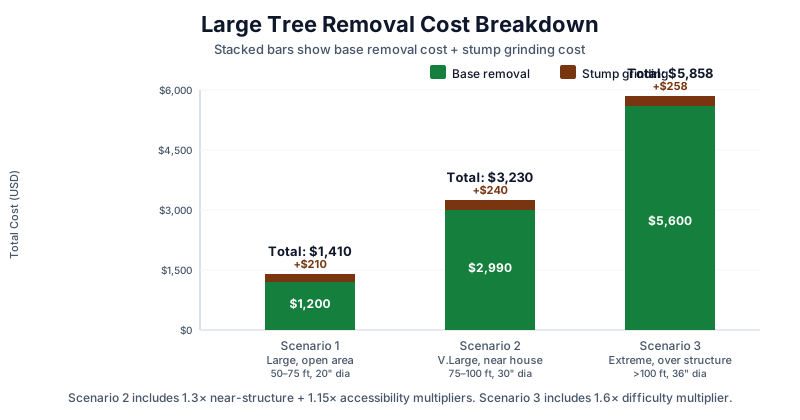
Big trees are impressive until you need to remove one. The sheer volume of wood, the equipment required, the time it takes, it adds up faster than most homeowners expect. A 70-foot oak in your backyard is not a $700 job. It's more likely a $2,000–$3,500 job before stump work.
This guide covers what "large" actually means to an arborist, why big trees cost more at every stage of the process, and what realistic price ranges look like for the most common large-tree scenarios.
What Counts as a "Large" Tree?
Tree services use height to categorize removal difficulty:
| Category | Height Range | Base Cost |
|---|---|---|
| Small | Up to 25 ft | $300 |
| Medium | 25–50 ft | $700 |
| Large | 50–75 ft | $1,200 |
| Very Large | 75–100 ft | $2,000 |
| Extreme | 100 ft+ | $3,500 |
For this guide, "large" covers everything from 50 feet up. These trees represent the jobs where specialized equipment, larger crews, and longer timelines significantly affect cost.
A 55-foot tree in your front yard is manageable with an experienced climbing crew. A 90-foot cottonwood in a tight backyard is a different category of job entirely, one that often requires a crane and a full day of work.
Why Large Trees Cost More: The Real Reasons
It's not just that there's more wood. It's every aspect of the job scales with tree size.
More Wood Volume to Manage
A 90-foot tree produces dramatically more wood volume than a 40-foot tree, not just in the trunk, but in the total canopy spread. That volume has to be cut, fed through a chipper, or hauled away in sections. A large tree job can fill a full-size dump truck or generate 3–5 chipper loads. That's time and disposal cost built into every large-tree quote.
Larger Equipment
Small trees can be climbed and removed by one arborist with a chainsaw and rope system. Large trees, particularly in confined spaces or near structures, require:
- Bucket trucks (aerial lifts): These give arborists reach into the upper canopy without climbing. Rental or depreciation cost is factored into large-tree pricing.
- Cranes: For trees over 80 feet in difficult locations, a crane may be the only safe option. Crane rental runs $300–$500 per hour, and a crane removal often takes 4–8 hours of crane time. That's $1,200–$4,000 in crane costs alone, before crew labor.
- Large chippers: Trunk sections from big trees, sometimes 20–30 inches in diameter, don't fit in a standard chipper. Large grinders or flat-bed hauling are needed.
Larger Crews
A 40-foot tree might be a 2-person job. A 90-foot tree in a confined area is typically a 4–5 person operation: the climber or bucket truck operator, a ground crew managing rigging, a chipper operator, and someone coordinating the overall operation. Each additional person adds to the daily labor cost.
Longer Job Timelines
Large trees can take a full day or more to remove safely. That's a full day of equipment rental, crew time, and, if there's a crane, crane rental. Some extreme-size trees near structures take 2 days to complete. This is why a 100+ foot tree can easily reach $5,000–$8,000 for the full job.
The Diameter Surcharge: Where Big Trees Get Even More Expensive
Large trees are almost always wide trees. The diameter surcharge adds $25 per inch over 24 inches of trunk diameter (measured at breast height, 4.5 feet up).
Here's what that looks like for common large-tree scenarios:
| Trunk Diameter | Surcharge | Formula |
|---|---|---|
| 24 inches | $0 | At threshold |
| 30 inches | $150 | 6 × $25 |
| 36 inches | $300 | 12 × $25 |
| 42 inches | $450 | 18 × $25 |
| 48 inches | $600 | 24 × $25 |
| 60 inches | $900 | 36 × $25 |
A large, old-growth hardwood, say a 90-year-old white oak with a 48-inch trunk, carries a $600 diameter surcharge on top of the $2,000 base cost for its height. Before location or condition factors, you're already at $2,600.
Species That Produce the Largest Trees
Not all large trees are created equal. Some species commonly reach extreme sizes that drive costs into the upper tiers:
White Oak and Live Oak, White oaks regularly reach 60–100 feet with trunk diameters of 30–60 inches in maturity. They're dense, heavy hardwoods that produce significant log volume. Live oaks in the South spread wide and low with massive canopies.
Cottonwood, One of the fastest-growing trees in North America, cottonwoods commonly reach 70–100 feet. They're also prone to structural weakness and often die or become hazardous before other species of similar size. A dead cottonwood over 80 feet is a complex removal.
Pine (Loblolly, White, Ponderosa), Large pines frequently reach 80–100+ feet. They're softer wood than hardwoods, which makes cutting easier, but the sheer height drives them into the very-large to extreme cost tiers.
Elm, American elm was once the dominant street tree in many cities. Mature elms often reach 60–80 feet with 30–40 inch trunks. Many are now being removed due to Dutch elm disease, which also affects condition multipliers.
Ash, Ash trees commonly reach 50–80 feet. The emerald ash borer has killed hundreds of millions of ash trees across North America, meaning many ash removals involve dead or compromised trees, adding the 1.15× dead-tree multiplier on top of large-tree base pricing.
Preparing Your Property for a Large Tree Removal
Before the crew arrives, there are a few things worth doing to protect your property and help the job go smoothly.
Clear the work zone. Move vehicles, outdoor furniture, potted plants, and anything fragile away from the tree and all likely fall zones. A 90-foot tree has a large radius, if it were to fall, it would reach farther than you'd intuitively expect. The crew will establish a safe perimeter, but clearing the area in advance helps.
Identify underground utilities. Before any stump grinding happens, call 811 (the national "Call Before You Dig" line) to have utility lines marked. Root zones from large trees can extend far from the trunk, and stump grinders can hit irrigation lines, gas lines, or electrical conduits.
Discuss access routes. Large-tree jobs often require driving heavy equipment across your lawn. Discuss with the crew where they'll bring equipment in and whether plywood boards or mats can be used to protect your turf.
Document the area. Take photos of your roof, siding, gutters, fencing, and landscaping before work starts. For large trees near structures, this protects you in case of accidental damage.
Wood Disposal Options
Large trees produce a lot of wood. What happens to it is worth discussing upfront.
Chipping on-site. The standard approach: branches and smaller sections are fed through a chipper and the chips are either hauled away or left on your property as mulch. Chips make excellent garden mulch, 6–8 inches of fresh wood chip mulch suppresses weeds effectively.
Log sections for firewood. If the tree is a hardwood (oak, maple, ash, elm), ask whether you can keep the trunk sections for firewood. Most crews will cut sections to your specified length and stack them, often for no additional charge, since it saves them hauling fees. You'll need to split and dry the wood for at least 6–12 months before burning.
Haul-away. If you want everything gone, haul-away is typically included in the quote for large-tree jobs. Confirm this upfront, some companies include it, others charge separately.
Two Real Quotes for Comparison
Example 1: Large Healthy Oak, Open Backyard
The tree: A 70-foot white oak, 36-inch trunk diameter, healthy, in an open area with clear access.
Base cost (large tree, 50–75 ft): $1,200
Diameter surcharge: 36 − 24 = 12 inches over threshold. 12 × $25 = $300
Condition multiplier (healthy): 1.0×
Location multiplier (open area): 1.0×
Subtotal: ($1,200 + $300) × 1.0 × 1.0 = $1,500
Stump grinding: $150 + (36 × $3) = $150 + $108 = $258
Total: $1,500 + $258 = $1,758
Low estimate: $1,758 × 0.75 = $1,319
High estimate: $1,758 × 1.30 = $2,285
Expected range: $1,300–$2,300
Example 2: Very Large Pine, Near the House
The tree: An 85-foot loblolly pine, 42-inch trunk diameter, healthy, with branches extending over the roofline.
Base cost (very large tree, 75–100 ft): $2,000
Diameter surcharge: 42 − 24 = 18 inches over threshold. 18 × $25 = $450
Condition multiplier (healthy): 1.0×
Location multiplier (over structure): 1.6×
Subtotal: ($2,000 + $450) × 1.0 × 1.6 = $2,450 × 1.6 = $3,920
Stump grinding: $150 + (42 × $3) = $150 + $126 = $276
Total: $3,920 + $276 = $4,196
Low estimate: $4,196 × 0.75 = $3,147
High estimate: $4,196 × 1.30 = $5,455
Expected range: $3,100–$5,500, and if the crew determines a crane is necessary, add $1,200–$3,000 on top.
Run your own numbers using our tree removal cost calculator. Input your tree's height, diameter, condition, and location and you'll get a realistic price range in under a minute.
Full Stump Removal vs. Grinding for Large Trees
For large trees, the stump is a bigger decision than for smaller ones. A 36-inch stump is substantial, grinding it takes a serious machine and 1–2 hours of additional work.
Stump grinding costs $150 + $3 per inch of diameter. For a 36-inch stump: $258. The stump is ground 6–12 inches below grade, and the chips fill the hole. Roots decay in place over 3–7 years.
Full stump removal costs $300 + $8 per inch of diameter. For a 36-inch stump: $588. This involves excavating the root ball and hauling it away, necessary if you're planting in the same spot or pouring concrete over the area.
For most homeowners, grinding is sufficient. The only cases where full removal makes sense are replanting in the exact location, constructing a hardscape directly over the root zone, or when root rot is suspected and you need to remove the root system to protect adjacent trees.
The stump grinding vs. removal guide covers this comparison in more detail with additional worked examples.
Getting the Right Quote for a Large Tree
Large-tree quotes vary more than small-tree quotes because there are more variables, crane requirements, crew size, access challenges, and disposal volume all affect price. Get at least 3 in-person quotes; don't accept phone quotes for trees over 60 feet.
Ask each arborist:
- Will this require a crane or bucket truck?
- How many crew members will you bring?
- Is debris hauling included or billed separately?
- Does the quote include stump grinding?
- Do you carry crane liability coverage (if a crane is used)?
Verify ISA certification at isa-arbor.com and check for TCIA membership at tcia.org. Both organizations provide searchable directories. For very large trees near structures, hiring a certified arborist isn't optional, it's the only way to ensure the job is done safely.
For more on what the full cost breakdown looks like across all tree sizes, the how much does tree removal cost guide covers everything from small trees to large ones with the complete formula.
For trees near your house specifically, the tree removal near house guide explains what to expect during sectional removal and how to protect your property.
Final Thoughts on Big Tree Pricing
Large tree removal starts at $1,200 for the base cost of a 50–75 foot tree in good condition with open access. Add a wide trunk, a compromised condition, or proximity to your house, and that number climbs fast, sometimes past $5,000 for a single tree with stump removal included.
The math isn't arbitrary. Every surcharge reflects a real increase in labor time, equipment cost, or risk. Understanding the formula puts you in a position to evaluate quotes accurately and spot when a bid is out of line.
Use our free large tree removal cost estimator to get a detailed breakdown for your specific tree before you start calling for quotes. It'll give you a realistic low-to-high range in under a minute.
Learn more about how this site's estimates are built and the data sources behind them on the about page.