How Much Does Tree Removal Cost in 2026? Full Breakdown
Find out exactly what tree removal costs in 2026, broken down by size, location, and condition with real numbers you can budget against.
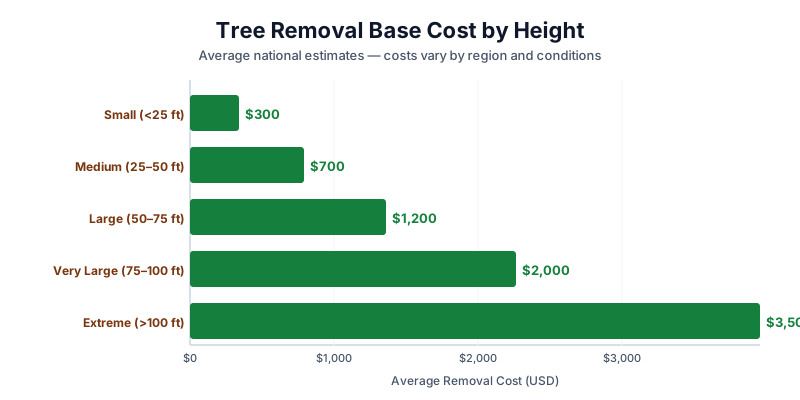
Tree removal costs in 2026 range from $300 for a small tree to $3,500 or more for an extremely large one before stump work, travel fees, or site complications are added. If you've ever gotten a quote and thought "how did they come up with that number?", this post walks through exactly how the price is built, and where you have room to push back.
Price Tiers by Tree Size
Arborists size trees by height. Here's what each tier typically costs based on industry benchmarks used by ISA-certified arborists and data from the Tree Care Industry Association (TCIA):
| Tree Size | Typical Height | Base Cost |
|---|---|---|
| Small | Up to 25 ft | $300 |
| Medium | 25–50 ft | $700 |
| Large | 50–75 ft | $1,200 |
| Very Large | 75–100 ft | $2,000 |
| Extreme | 100 ft+ | $3,500 |
These are baseline figures for a healthy tree in an open area. Every other factor, trunk diameter, condition, and access, stacks on top of them.
Trunk Diameter Surcharge
Most quotes include a diameter surcharge once a trunk exceeds 24 inches. The industry standard is roughly $25 per inch over that threshold. A 36-inch trunk adds $300 to the base price. A 48-inch trunk adds $600.
This matters because wide trunks mean more wood volume, heavier sections to rig down safely, and more time on the ground cutting and hauling.
When You're Comparing Quotes
If two arborists quote you wildly different prices, ask both of them to measure the trunk diameter and confirm the height estimate. Quotes often diverge because one arborist is measuring DBH (diameter at breast height, about 4.5 feet up) while another is eyeballing the crown spread.
What Drives the Cost Up (Beyond Tree Size)
Tree Condition
A dead tree costs more to remove than a healthy one. Dead wood is unpredictable, limbs can snap unexpectedly during cutting, making rigging and drop zones harder to control. Here's how condition affects price:
- Healthy tree: Base price (1.0x multiplier)
- Dead tree: 15% more (1.15x)
- Storm-damaged tree: 25% more (1.25x)
- Significantly leaning tree: 35% more (1.35x)
A leaning tree doesn't automatically need removal, but if the lean is toward your house, the ISA recommends a hazard assessment before any work starts.
Location and Access
Where the tree sits on your property is often the single biggest cost driver after size. A 50-foot tree in your open backyard costs much less to remove than the same tree growing over your garage:
- Open area: No surcharge (1.0x)
- Near a structure: 30% more (1.3x)
- Directly over a structure: 60% more (1.6x)
- Near power lines: 50% more (1.5x)
- In a confined backyard: 25% more (1.25x)
The "over structure" scenario requires piece-by-piece rigging, the crew can't fell the tree in one controlled drop, so every section has to be roped down. That doubles the labor time on most jobs.
Regional Variations
Labor rates vary significantly by region. In the Northeast and Pacific Coast, expect to pay 20–40% above national averages. The Midwest and South tend to run closer to the baseline numbers above. Urban markets like New York City, Boston, and San Francisco can run 50–70% above baseline for the same job.
Permit requirements also vary. Some municipalities require a permit for any tree over 6 inches DBH, others only care about heritage trees. See our permit guide for what to check before you book.
Stump Costs: The Add-On Most People Forget
Most tree removal quotes don't include the stump unless you ask. There are two options:
Stump grinding, The stump is ground down 6–12 inches below grade. Cost: $150 + $3 per inch of diameter. A 20-inch stump runs $210; a 36-inch stump runs $258.
Full stump removal, The root ball is excavated and hauled away. Cost: $300 + $8 per inch of diameter. A 20-inch stump runs $460; a 36-inch stump runs $588.
Grinding leaves roots to decay in place over 3–7 years. Full removal is necessary if you're planting a new tree in the same spot or pouring a foundation. For most homeowners, grinding is sufficient, it's faster, cheaper, and the hole is easy to fill with topsoil.
Sample Calculation: Medium Tree Near a Structure
Picture this: a 40-foot oak growing 8 feet from your detached garage. The trunk measures 28 inches in diameter. The tree is healthy and there's a gate to get equipment into the backyard.
Here's how the cost builds:
- Base cost (medium tree, 25–50 ft): $700
- Diameter surcharge (28" − 24" = 4" over threshold × $25): +$100
- Condition multiplier (healthy, 1.0x): $0 added
- Location multiplier (near structure, 1.3x): $800 × 1.3 = $1,040
- Stump grinding (28" diameter): $150 + (28 × $3) = $234
Total estimated range: $1,040 × 0.75 = $780 (low) to $1,040 × 1.30 = $1,352 (high), plus $234 for stump grinding.
All-in estimate: $1,014–$1,586
You can run this same math for your specific tree using our tree removal cost calculator, enter your tree's height, diameter, condition, and location and you'll get a low-to-high range in seconds.
Multi-Tree Discounts
If you have more than one tree to remove, ask for a multi-tree discount before signing anything. Most arborists price this at 5% per additional tree, up to 20% total. Bringing in a crew, getting permits, and staging equipment has fixed overhead, they'd rather discount slightly and do two jobs in one visit.
What's Typically Included in a Quote
Standard quotes from TCIA-member companies usually include:
- All cutting, sectioning, and ground-level cleanup
- Wood chipping or hauling of branches and trunk sections
- Basic site cleanup (raking debris)
What's usually not included unless negotiated:
- Stump grinding or removal
- Log splitting for firewood (some companies offer this for a fee)
- Hauling away soil displaced by root removal
- Travel fees for properties more than 30 miles out
Always ask for an itemized quote. A lump-sum number makes it harder to compare bids.
How to Get a Fair Price
Get at least 3 quotes. Ask each arborist for their ISA certification number, you can verify it on the ISA website at isa-arbor.com. Avoid anyone who doesn't carry liability insurance and workers' compensation; if a crew member is injured on your property without coverage, you can be held liable.
The TCIA's "Find a Tree Care Company" directory lists certified and insured companies by zip code. It's a reliable starting point.
Timing also matters. Late winter (January–March) is generally the slowest season for tree crews, you may get 10–15% off just by scheduling then. Read more in our guide on the best time to remove a tree.
Putting It All Together
Tree removal cost in 2026 starts at $300 for a small tree and can reach $5,000+ for a very large tree over a structure with stump removal included. The formula isn't arbitrary, it reflects real labor hours, equipment costs, and risk.
Understanding how each factor contributes means you can ask better questions, compare quotes accurately, and spot when a bid is out of line.
Ready to get a real estimate for your specific tree? Use our free tree removal cost calculator, it runs the full formula in under 60 seconds and gives you a low-to-high range to walk into any arborist conversation prepared.
Want to dig into exactly which factors move the needle most? See our breakdown of what drives tree removal cost and our detailed guide on large tree removal costs.
Learn more about how we build these estimates on our about page.