Best Time of Year to Remove a Tree (And How to Save Money)
Timing your tree removal right can save you 10–20% or more. Here are the best and worst months to book, and when you should not wait.
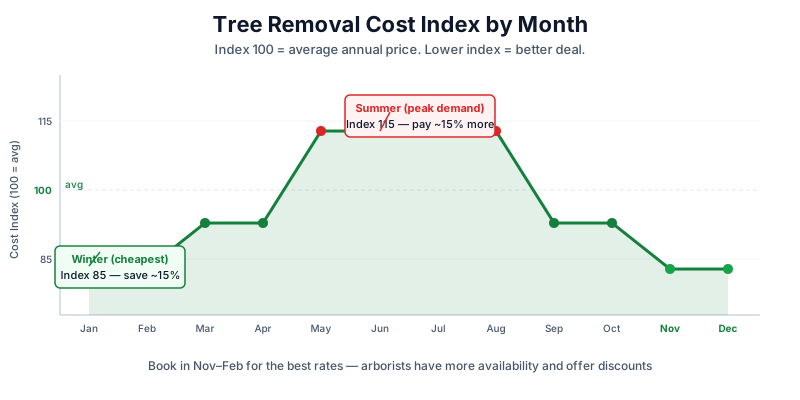
Tree removal isn't cheap, and the date on your calendar affects the price more than most homeowners realize. Book in July and you might pay peak rates because every crew in your area is booked solid. Schedule the same job in February and you might negotiate 10–20% off simply because business is slow.
This guide breaks down how each season affects tree removal pricing, when it's genuinely worth waiting to save money, and, just as importantly, when it's not.
Why Timing Affects Tree Removal Cost
Tree service companies have fixed overhead year-round: trucks, equipment, insurance, and payroll for their core crew. But demand isn't evenly distributed. Most homeowners call for tree work in spring and summer when their yards are in full view and storm season is approaching.
When demand is high, companies are fully booked and have no incentive to discount. When demand drops in winter, those same companies need to keep crews working, and a small discount is worth more to them than downtime.
Seasonal availability also affects lead times. In peak season, getting on a crew's schedule might take 3–6 weeks. In winter, many companies can schedule within a week or two.
The Best Time: Late Winter (January–March)
Late winter is the best time to remove a tree for two reasons: cost and conditions.
Pricing. This is the slowest period for most tree service companies outside the South. Crews are available, competition for scheduling slots is low, and many companies, especially smaller owner-operated ones, are willing to negotiate. You can realistically expect 10–20% off peak-season pricing by scheduling between January and early March.
Working conditions. Deciduous trees are fully dormant and leafless, which makes a couple of things easier for the crew. Without leaves, arborists can see the branch structure clearly and assess the tree's condition before cutting. There's also less debris to chip and haul, branch volume can drop 20–30% once the leaves are gone.
In colder climates, frozen ground is another advantage. Heavy equipment like stump grinders, chippers, and skid steers tear up lawn turf when the soil is soft. Frozen ground minimizes that damage, you won't be left with tire ruts across your yard in February the way you might in October after a wet week.
The main trade-off with winter timing: if you're removing a tree because of an aesthetic concern (you want to see the space it opens up before you landscape), you'll be waiting until spring to see the results. For most homeowners, that's a fine trade for meaningful savings.
Second Best: Late Fall (October–November)
Once the leaves start to drop and homeowners shift attention indoors, demand for tree services eases. October and November often bring pricing that's 5–15% below peak rates, and crew availability improves.
Fall is also a good time to assess trees that were stressed during summer drought, their condition is visible in the canopy before full leaf drop. If a tree struggled through a dry summer, a fall inspection can catch problems early and let you schedule removal before winter.
Spring: A Mixed Bag
Early spring, March through April, can offer decent pricing if crews are still ramping up. But once the season picks up, usually by late April or May, pricing climbs back toward peak. Spring is also when most municipalities start enforcing tree ordinances more actively, so permit requirements are more consistently enforced.
One practical advantage to spring removal: the ground is workable but not yet hardened from summer drought, making stump grinding easier and less damaging to surrounding lawn.
The Most Expensive Time: Summer (June–August)
Summer is peak season for tree services. Homeowners are outside, seeing their trees, assessing storm damage from spring weather, and planning landscaping projects. Demand is at its highest, crews are fully booked, and wait times are longest.
Summer also brings the most challenging working conditions. Full leaf canopy means more debris to process, harder-to-see branch structure, and more weight in the crown. Heat affects crew productivity. Dry ground makes stump grinding more difficult.
Expect to pay full published rates or above during summer, with wait times of 3–6 weeks in many markets. Emergency work in summer carries additional surcharges, some companies charge 20–30% above standard rates for same-week emergency removals during peak season.
If your tree isn't urgent and you're calling in June asking for July availability, it's worth asking: "Is there any discount to push this to late January?" A surprisingly high number of companies will say yes.
When You Should NOT Wait for a Better Season
Seasonal savings are real, but there are situations where waiting creates risk that outweighs any price benefit.
Dead or dying trees. A tree that's confirmed dead deteriorates quickly. Waiting 4–6 months can mean the difference between a straightforward removal and a crane-required job, plus a price increase of $500–$1,500. The dead tree removal cost guide explains exactly how quickly the cost escalates as wood decays.
Significantly leaning trees. A tree that has developed a noticeable lean, especially toward a house, fence, or power lines, is not stable. Lean doesn't self-correct. Wind and saturated soil create the conditions for sudden failure, and there's no seasonal window that makes this safe to delay.
Storm-damaged trees. Broken limbs hanging in the canopy ("widow makers") are one of the most dangerous conditions an arborist deals with. If a storm left your tree with major structural damage, remove it before the next weather event arrives.
Trees near power lines. If a tree is growing into or near utility lines, contact your utility company. They often handle line-adjacent trimming or removal separately from private contractors, and the urgency here isn't about money.
For guidance on evaluating whether your specific tree is genuinely urgent, the when to remove a tree guide covers the specific conditions, lean angle, root damage, crown dieback, that warrant immediate action.
Real Numbers: Same Tree, Summer vs. Winter
Here's what the seasonal price gap looks like in real dollars.
The tree: A 55-foot healthy red maple, 26 inches in diameter, in an open backyard.
Base cost (large tree, 50–75 ft): $1,200
Diameter surcharge: 26 inches is 2 inches over the 24-inch threshold. 2 × $25 = $50
Condition multiplier (healthy): 1.0×
Location multiplier (open area): 1.0×
Pre-discount subtotal: $1,200 + $50 = $1,250
Stump grinding (26-inch diameter): $150 + (26 × $3) = $150 + $78 = $228
Base total: $1,250 + $228 = $1,478
In summer (peak pricing, no discount):
- Low estimate: $1,478 × 0.75 = $1,109
- High estimate: $1,478 × 1.30 = $1,921
- Most likely range: $1,100–$1,900
In January (15% off-season discount applied):
- Discounted total: $1,478 × 0.85 = $1,256
- Low estimate: $1,256 × 0.75 = $942
- High estimate: $1,256 × 1.30 = $1,633
- Most likely range: $940–$1,630
The off-season scheduling saves roughly $200–$300 on this job, not a dramatic number, but meaningful when you factor in that stump grinding and cleanup can push totals higher, and multi-tree jobs would see proportionally larger savings.
Use our tree removal cost calculator to model your specific tree's cost before approaching arborists for quotes.
How to Get Off-Season Quotes
Getting a winter discount isn't automatic, you need to ask.
When you call for quotes in late fall or winter, mention directly that you're flexible on scheduling and looking for off-season pricing. Many companies won't volunteer the discount; they'll give you the standard rate unless you ask specifically.
You can also frame it as: "I'm getting quotes now and planning to schedule in January or February, is there any flexibility on price for that timing?" This signals that you're a real, committed prospect (not just fishing for quotes) and gives the company reason to offer a better number.
Get at least 3 quotes regardless of season. ISA certification and verified liability insurance matter more than shaving the last $50 off a quote. You can verify ISA credentials at isa-arbor.com and find TCIA-member companies at tcia.org.
Scheduling 2–3 Months Ahead
If you want winter pricing or just a spot on a good crew's schedule, plan 2–3 months ahead. It pays off.
The best arborists, ISA-certified, well-reviewed, properly insured, stay booked. They don't have open slots next week in July. But they can often hold a late January slot if you call in November. You lock in the date, they come do an in-person estimate to confirm the scope, and you're on the schedule before the winter rush (what little there is of one) kicks in.
If you're also navigating a permit requirement, give yourself even more lead time. Permit processing takes 1–4 weeks in most cities, and you want the permit in hand before the crew shows up. The tree removal permit guide covers the full application process.
The Multi-Tree Factor
If you have 2 or more trees to remove, the seasonal savings compound.
Most arborists offer a 5% discount per additional tree, up to 20% total, on multi-tree jobs regardless of season. Add a 10–15% off-season pricing advantage and you're looking at meaningful savings, especially on a large property with multiple trees to remove.
Schedule your multi-tree job in winter, ask for the multi-tree discount explicitly, and you can realistically reduce a $6,000 summer quote to $4,500–$5,000 for the same work. That's real money that's worth a little scheduling flexibility.
For the full breakdown on how multiple trees affect pricing, the tree removal cost factors guide covers the complete formula including stacking discounts and how arborists handle multi-day jobs.
What This Means for You
The best time to remove a tree, purely from a cost standpoint, is late winter, January through early March. You'll find more available crews, better pricing, and working conditions that are actually favorable for the job.
Summer is the worst time to book from a cost perspective, though it's unavoidable if your tree is an immediate hazard. Fall is a solid middle ground.
The most important rule: don't wait for a better season when the tree poses a real risk. A dead tree, a leaning tree, or a storm-damaged tree doesn't get safer with time, it only gets more expensive.
Ready to know what your tree should cost before you start calling? Get your free estimate using our tree removal cost calculator, enter your tree's size, condition, and location for a full price breakdown in under a minute.
Learn more about how this site's estimates are built on the about page.