Dead Tree Removal Cost: Why It's Often More Expensive
Dead trees cost 15% more to remove than healthy ones, and waiting makes it worse. Here's what drives the price and when to act.
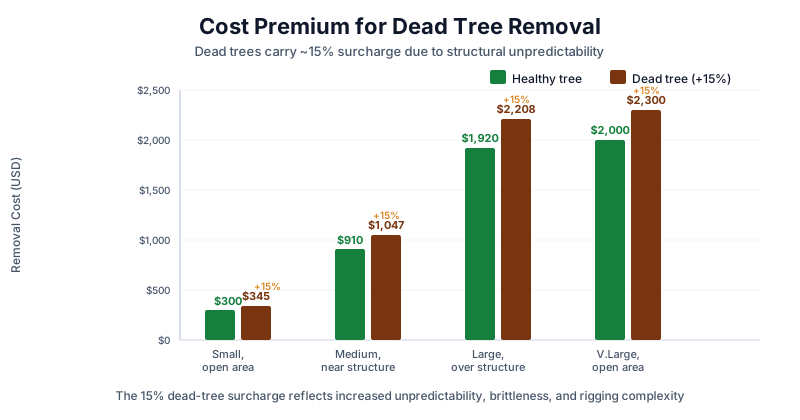
You'd think a dead tree would be easier to remove. No leaves, lighter wood, less bulk. But if you've gotten quotes recently for a dead tree, you probably noticed the number was higher than you expected.
Dead trees carry a 15% price premium, sometimes significantly more, and there are real, technical reasons for it. Understanding those reasons helps you make a smarter decision about whether to act now or wait. Spoiler: waiting almost always costs more.
Why Dead Trees Cost More to Remove
When a tree dies, the wood begins to decay from the inside out. What looks solid on the outside may be punky and brittle at the core. This changes everything about how an arborist can safely work on it.
Unpredictable Wood Behavior
Live wood has elasticity. When a saw cuts through it, the wood responds in predictable ways, it bends, it hinges, it falls where it's directed. Dead wood doesn't. It can snap without warning, shatter into chunks, or separate at a weak point mid-cut, not where the arborist intended.
The International Society of Arboriculture (ISA) classifies dead and decaying trees as higher-risk work specifically because of this unpredictability. An arborist working on a dead tree faces a meaningfully higher chance of unexpected failure at any stage of the job.
Extra Rigging Requirements
Because the wood is unreliable, arborists can't always rely on the trunk or major limbs to hold a climber's weight the way they would with a live tree. Dead trees often require:
- Bucket trucks or cranes instead of traditional rope climbing, since limbs may not support body weight
- Shorter cutting sections (4–6 feet instead of 8–12 feet) to reduce the load at each attachment point
- More personnel on the ground managing controlled descents
That's more labor hours and, in some cases, more equipment, both of which show up in your quote as a price premium.
The 1.15× Condition Multiplier
Our tree removal cost calculator applies a 1.15× condition multiplier for dead trees. That means a job priced at $1,200 for a healthy tree becomes $1,380 for the same tree after it dies, before any other factors like trunk diameter or location are added.
It's actually a conservative number. Real-world quotes can run higher, particularly for trees that have been dead for more than a year and have visible rot, fungal conks, or soft spots in the trunk. Some arborists price dead trees 20–30% above healthy-tree rates when the decay is advanced.
How to Tell If a Tree Is Dead or Just Dormant
This is one of the most common questions homeowners ask, and it matters before you call anyone. A dormant tree in late fall or winter looks a lot like a dead one.
The Scratch Test
Find a small twig and scratch through the outer bark with your fingernail or a pocket knife. A live tree will show green or cream-colored cambium tissue just under the bark. A dead tree will show brown, dry tissue with no green at all.
Do this test in multiple spots at multiple heights. A tree can be partially dead, with live tissue in the lower trunk and dead sections in the upper crown, or vice versa.
Other Signs a Tree Has Died
- No leaf-out in spring when neighboring trees of the same species have leafed out normally
- Bark that peels away without revealing fresh bark underneath, just dry, bare wood
- Fungal conks (shelf mushrooms) growing on the trunk or base, which signal internal decay
- Vertical cracks or splits that weren't there previously and are getting wider
- Concentrated woodpecker activity on the trunk, woodpeckers excavate dead wood to find the insects that colonize it
If you're still not sure, a certified arborist can assess the tree before you commit to anything. Many offer free or low-cost consultations. The when to remove a tree guide covers this in more detail, including how to assess structural defects and leaning.
How Quickly Dead Trees Deteriorate
Faster than most homeowners expect.
In the first year after death, the tree is at its most manageable state for removal. The wood is dry and brittle, but internal decay hasn't spread far. Rigging points are still relatively sound. This is the window when the 1.15× premium applies and you can get straightforward quotes.
By year two, internal decay accelerates, especially in the heartwood. Fungal growth spreads through the root system. The root plate begins to lose its grip on the soil, and the whole tree becomes less stable in wind.
By year three or four, many dead trees become what arborists call "hazard trees", meaning they could fail without significant triggering force. At that point, you're not just paying a 15% premium. You may be dealing with crane-required removal, emergency scheduling rates, or both.
The practical takeaway: if you know a tree is dead, removing it within 6–12 months is almost always the cheapest window.
Insurance Implications of Leaving a Dead Tree
Your homeowner's insurance policy likely covers sudden, unexpected tree damage, a live tree that falls in a storm, for instance. What it often doesn't cover is damage from a tree that was known to be dead or structurally compromised.
If your insurer can establish that you knew the tree was dead and failed to act, through neighbor complaints on record, previous contractor assessments, or a simple inspection, they may deny your claim for the resulting property damage.
This is worth a direct phone call to your insurance agent before you decide to delay removal. Ask specifically whether your policy has "known hazard tree" exclusions and what documentation would be used to establish prior knowledge.
A Real-World Comparison: Dead Tree, Two Scenarios
Compare the same tree in two situations, open yard versus near the house.
The tree: A 70-foot cottonwood, 28 inches in diameter, confirmed dead within the last 6 months.
Scenario A: Open Backyard, Clear Access
Base cost by height: Very large tree (75–100 ft) = $2,000
Diameter surcharge: 28 inches is 4 inches over the 24-inch threshold. 4 × $25 = $100
Condition multiplier (dead): 1.15×
Location multiplier (open area): 1.0×
Subtotal: ($2,000 + $100) × 1.15 = $2,100 × 1.15 = $2,415
Stump grinding: $150 + (28 × $3) = $150 + $84 = $234
Total: $2,415 + $234 = $2,649
Low estimate: $2,649 × 0.75 = $1,987
High estimate: $2,649 × 1.30 = $3,444
Scenario B: Same Tree, Near the House
Same tree, but positioned within 15 feet of the structure.
Location multiplier (near structure): 1.3×
Subtotal: ($2,000 + $100) × 1.15 × 1.3 = $2,100 × 1.495 = $3,140
With stump grinding: $3,140 + $234 = $3,374
Low estimate: $3,374 × 0.75 = $2,531
High estimate: $3,374 × 1.30 = $4,386
The proximity to the house adds roughly $725 to the expected price, before factoring in how dead wood behaves when it's being sectioned over a roof. Many arborists apply an additional risk premium on top of the formula multiplier for dead-near-structure situations.
Use our detailed tree removal cost estimator to run your specific numbers and get a realistic range to take into arborist conversations.
The Dangers of Leaving a Dead Tree Standing
Beyond cost, there's the safety question. Dead trees fail without warning. No gradual lean, no creak, no obvious sign. A dry summer day, moderate wind, or saturated soil after rain can be enough.
Common failure modes include:
- Whole-tree uprooting when root decay reaches a tipping point and the root plate can no longer hold
- Crown drop where a large limb separates from the trunk spontaneously, without any external force
- Stem failure at a rot pocket, usually mid-trunk, where the top half of the tree topples over
According to the Tree Care Industry Association (TCIA), a significant portion of storm-related tree damage involves trees that were already dead or structurally compromised before the storm hit. The storm doesn't cause the failure, it just triggers a failure that was already waiting to happen.
If the dead tree is within striking distance of your house, a parked vehicle, a fence, power lines, or anywhere children play, treat it as urgent, not someday.
Partial Death: When Only Part of the Tree Has Died
Sometimes a tree isn't fully dead. One or two major limbs have died while the rest of the tree is still alive, this is called "partial crown dieback" and it warrants an arborist assessment rather than an automatic removal decision.
In many cases, the dead sections can be pruned out while the live portions are retained, at a fraction of the cost of full removal. An ISA-certified arborist can tell you whether the remaining live canopy is structurally sound or whether the overall tree integrity is too compromised to save.
Don't assume a tree with some dead limbs needs to come down entirely. Get an opinion first.
Getting a Reliable Quote
When you contact arborists for quotes on a dead tree, be upfront about the condition and, if you know it, how long the tree has been dead. Some contractors inspect first before quoting; others quote based on your description. A contractor who insists on an in-person inspection before giving a number is almost always more reliable.
Ask whether their quote accounts for the wood condition. A good arborist will mention it unprompted, they'll explain why a dead tree is more involved than a healthy removal. If a contractor gives you a suspiciously low number without mentioning anything about condition, ask them directly how they're accounting for the dead wood.
You can read about how this site's cost estimates are built on the about page, including the sources behind the condition multiplier figures.
For the full picture on removal costs across all tree types, see the how much does tree removal cost guide. And if the tree is also close to your house, the tree removal near house guide explains the sectional removal process and how the structure multiplier stacks with the condition multiplier.
Act Before It Gets More Expensive
Dead trees don't get cheaper with time. They get more dangerous and harder to remove. A tree that's been dead for under a year in an open area might cost $1,800–$2,700 to remove. The same tree two years later, with significant decay and growing near a structure, may run $4,000–$6,000, or require a crane.
If you've confirmed a tree on your property is dead, the financially and physically safest decision is removing it this season, not next year.
Get an accurate estimate for your specific tree using our free tree removal calculator. Enter the height, diameter, condition, and location and you'll have a realistic price range in under a minute.